Whether: Meaning, Usage, Grammar, and Examples in English
The word “whether” is a common but important part of English grammar. It is mainly used when someone is talking about uncertainty, two possibilities, alternatives, or a decision that has not yet been made. Although it looks simple, many English learners become confused about how to use whether correctly, especially when choosing between whether and if. Understanding its meaning and grammatical role can make both spoken and written English clearer and more natural.
Whether appears frequently in everyday conversations, academic writing, professional communication, news articles, and formal documents. It can introduce indirect questions, connect alternatives, and show that something may happen regardless of a particular condition. Learning the correct use of whether also helps writers avoid common mistakes involving “whether or not,” “whether to,” and the difference between weather and whether.
What Does Whether Mean?
Whether is mainly a conjunction used to introduce two or more possibilities. It is commonly connected with situations involving uncertainty, doubt, choice, or alternatives. For example, someone might say, “I do not know whether she will come.” In this sentence, the speaker is uncertain about the possibility of the person coming. The word whether introduces that uncertainty naturally.
Whether can also introduce an indirect question. Instead of asking directly, “Is he ready?” someone could say, “I wonder whether he is ready.” The meaning remains connected to a yes-or-no possibility, but the sentence becomes indirect. This structure is especially useful in formal communication, polite conversation, academic writing, and professional English because it allows uncertainty to be expressed clearly without asking a direct question.
How to Use Whether in a Sentence
Whether often appears after verbs that express uncertainty, thinking, asking, deciding, knowing, wondering, or checking. Common examples include “I wonder whether it will work,” “She asked whether he was available,” and “We need to decide whether the plan is practical.” In each example, whether introduces a situation in which more than one answer or possibility exists.
The word can appear at different points in a sentence depending on the structure. A sentence may begin with whether, as in “Whether he agrees is still unclear.” It may also appear after another clause, such as “Nobody knows whether the meeting will happen.” In natural English, the position of whether depends on what information the speaker wants to introduce, but its basic purpose remains the same: it connects uncertainty or alternative possibilities to the rest of the sentence.
Whether vs If: Understanding the Difference
Whether and if can sometimes be used in similar situations, particularly when introducing indirect yes-or-no questions. For example, “I do not know whether he is coming” and “I do not know if he is coming” are both commonly understood. In everyday conversation, many native speakers use if naturally in sentences like these because it sounds simple and informal.
However, whether is often more precise when clear alternatives are involved. Consider the sentence, “We need to decide whether to stay or leave.” Using whether makes the choice between two possibilities very clear. The word if is more strongly connected with conditions, such as “If it rains, we will stay inside.” For formal or careful writing, whether is often a better choice when the meaning involves uncertainty or alternatives rather than a condition that produces a result.
Understanding Whether or Not
The phrase “whether or not” is used when both possibilities are being considered. For example, “We need to decide whether or not to attend the event” means that attending and not attending are both possible choices. The phrase can make the two alternatives more explicit, although in many sentences the words “or not” are not necessary because the idea is already understood.
Whether or not can also mean that something will happen regardless of the situation. For instance, “I am going whether or not you come” means the speaker intends to go in either case. This use is slightly different because the sentence is no longer mainly about uncertainty. Instead, it emphasizes that the final action or result will remain unchanged regardless of which possibility becomes true.
How Whether…Or Expresses Alternatives
One of the most useful structures involving whether is “whether…or.” It is used when two alternatives are presented. A sentence such as “She could not decide whether to study medicine or engineering” clearly presents two possible choices. This construction is common whenever people are discussing decisions, preferences, possible outcomes, or competing options.
The alternatives do not always have to be simple actions. They can also involve complete ideas. For example, “Whether the company succeeds or fails will depend on its strategy.” Here, the alternatives are success and failure. The structure can also emphasize that both possibilities lead to the same result, as in “Whether you agree or disagree, you should listen carefully.” This makes whether…or useful for both everyday communication and more formal writing.
Using Whether Before an Infinitive
Whether is commonly used before a “to” infinitive when someone must make a decision. Examples include “I do not know whether to call,” “She is deciding whether to apply,” and “They discussed whether to continue.” In each sentence, the person is considering an action but has not yet decided what to do.
This structure is important because if usually cannot replace whether naturally before a to-infinitive. For example, “I do not know if to call” is not standard English, while “I do not know whether to call” is correct. Learning this rule helps writers choose between whether and if more accurately. Whenever the structure involves deciding whether to do something, whether is normally the correct and natural choice.
Whether in Formal and Everyday English
Whether is especially common in formal English because it clearly introduces questions, alternatives, and uncertainty. Business reports may discuss whether a project is financially practical. Academic papers may examine whether evidence supports a particular conclusion. Journalists may investigate whether a statement is accurate. In these contexts, whether creates a careful and neutral tone that works well when information is uncertain or still being evaluated.
The word is also widely used in ordinary speech. People regularly say things such as “I am not sure whether he knows,” “Can you check whether the shop is open?” or “We are deciding whether to travel this weekend.” Although if is sometimes more conversational, whether remains completely natural in everyday English. Choosing between the two usually depends on sentence structure, clarity, and the type of meaning being expressed.
Weather vs Whether: A Common Spelling Mistake
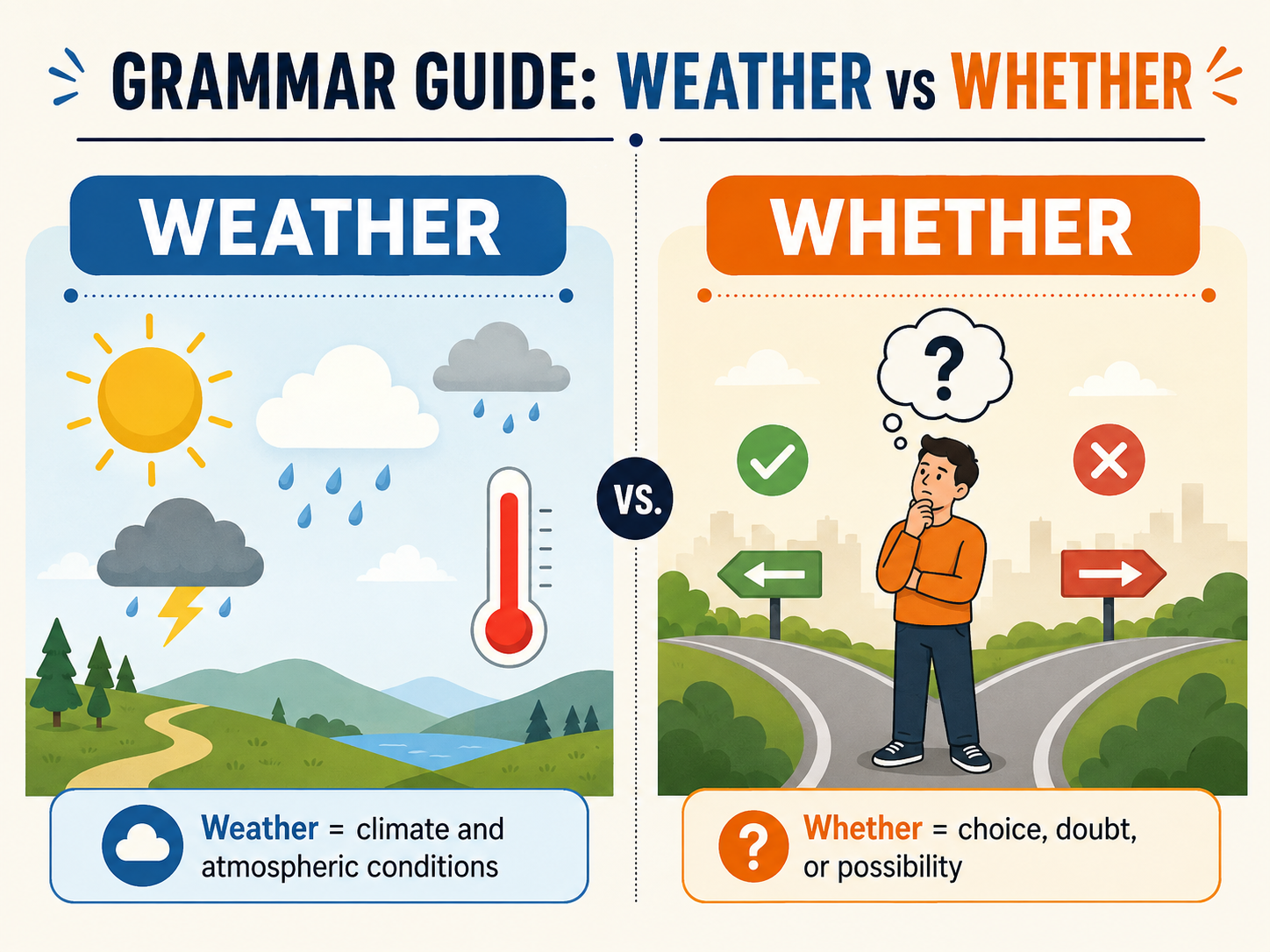
Whether is sometimes confused with weather because the two words sound almost the same in spoken English. However, their meanings are completely different. Weather refers to atmospheric conditions such as rain, sunshine, wind, temperature, snow, and storms. A person may say, “The weather is beautiful today.” Whether, on the other hand, introduces uncertainty or alternatives, as in “I do not know whether it will rain today.”
The easiest way to remember the difference is to focus on meaning rather than pronunciation. If the sentence is discussing climate or conditions outside, weather is probably the correct word. If the sentence involves a choice, uncertainty, doubt, or two possibilities, whether is likely correct. Understanding this difference is particularly important in writing because spell-checking software may not always identify the mistake when both words are spelled correctly.
Common Mistakes When Using Whether
One common mistake is replacing whether with if in every situation. Although the words can sometimes be interchangeable, there are structures where whether is clearer or grammatically necessary. Before a to-infinitive, for example, whether should normally be used. Similarly, when alternatives are clearly stated with “or,” whether often produces a more natural and precise sentence.
Another mistake is unnecessarily writing “whether or not” when whether alone already communicates the intended meaning. A sentence such as “I am wondering whether or not she received the email” is correct, but “I am wondering whether she received the email” is usually shorter and equally clear. Writers should choose the longer form when “or not” adds emphasis or when the meaning is “regardless of whether something happens.”
Conclusion
Whether is an essential English conjunction that helps speakers and writers express uncertainty, decisions, alternatives, and indirect questions. It can introduce simple doubts, connect two possibilities through the whether…or structure, and appear before infinitives when someone is considering an action. Understanding these patterns makes it much easier to use the word accurately in both formal and conversational English.
The most important distinction to remember is that whether usually deals with alternatives or uncertainty, while if is often associated with conditions. It is also important not to confuse whether with weather, despite their similar pronunciation. By understanding the meaning of whether, learning common sentence structures, and recognizing situations where it is preferred over if, English learners can communicate with greater accuracy, confidence, and clarity.
